
When You Realize Your Life Didn’t Start With You
The hidden influence of ancestors.

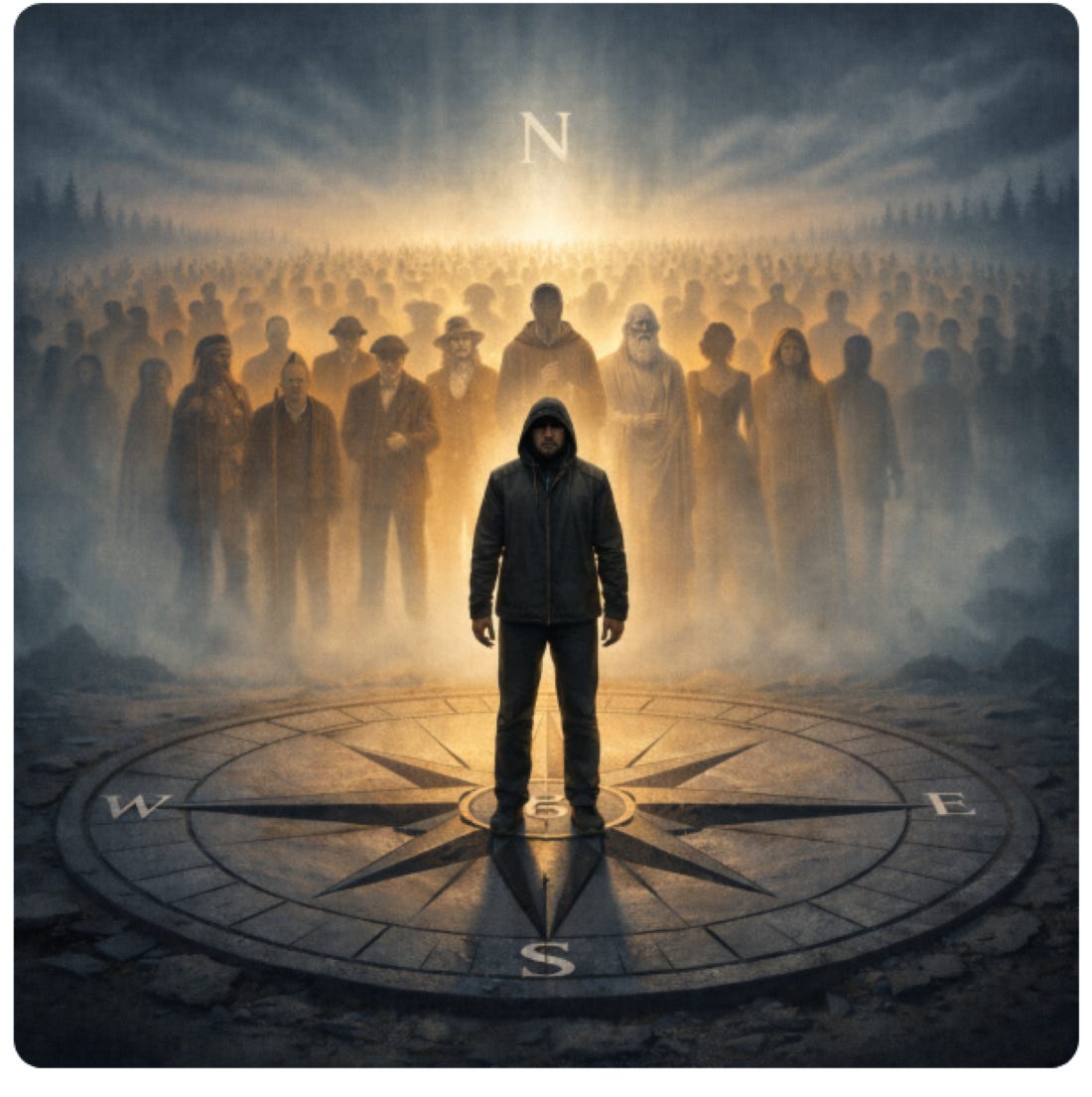
You probably think your money problems are about you.
Your discipline.
Your decisions.
Your mindset.
But what if the beliefs shaping your relationship with money were already inside you?Long before you ever earned your first dollar?
What if scarcity isn’t just a habit of thought…
What if it’s inherited?
Not only through family stories and childhood experiences.
But through generations of people who lived in worlds where survival meant holding tightly to everything.
Think about the people in your family who lived through hard times.
What did they have to believe in order to survive?
When I began looking closely at my own beliefs about money, I realized something uncomfortable.
Many of them were not mine.
They belonged to my ancestors.
Looking backward through the family line
When I started exploring where my beliefs about money came from, I went back through my family history as far as I reasonably could.
As a writer, I naturally started imagining what their lives must have been like from the fragments of information I could find.
Small details began turning into stories.
Farmers.
Laborers.
People who lived through economic instability that I can barely imagine now.
Wars.
Hard winters.
Generations where survival meant working with whatever was available and hoping it would be enough.
Scarcity wasn’t just an idea to them.
It was reality.
When you look at life through that lens, holding tightly to resources isn’t irrational.
It’s survival.
And slowly I began to see something clearly.
Scarcity didn’t start with me.
It traveled through generations.
When the past stops feeling distant
While researching my ancestors, something unexpected happened.
The more I looked into my family tree, the more fascinated I became by the people I was finding.
They stopped feeling like distant names in a record.
It started to feel more like standing in a room filled with people who had quietly been there all along.
Many cultures throughout the world actively honor their ancestors. Some keep altars with photographs or personal objects belonging to those who came before them. Sometimes incense is burned. Sometimes there are special days devoted to remembrance.
The exact practices vary, but the idea behind them is simple.
The people who came before us are still part of the story.
The writer Alex Haley once said:
“In all of us there is a hunger, marrow-deep, to know our heritage.”
Looking back into our lineage is one way we begin understanding ourselves.
When the veil grows thin
In pagan traditions, one of the most well-known times to honor ancestors is Samhain — what many people recognize as Halloween.
It is considered a time when the veil between the living and the dead becomes thin.
A moment when communication with ancestors becomes easier.
I have been fortunate to experience this connection for many years.
At first, I thought I was simply connecting with my family line.
My grandparents.
Their parents.
And the generations behind them.
But the more I explored ancestor work, the more something surprising began to appear.
It wasn’t just my blood relatives showing up in the story.
It felt like the past itself was much larger than I had imagined.
Eventually I learned why.
The six circles of ancestors
Most people think of ancestors as the relatives in their family tree.
But many traditions describe several different circles of ancestors.
Learning this changed the way I understood the past.
Because suddenly the number of people connected to our lives grows much larger.
Ancestors of Blood (DNA)
These are the relatives in our family tree — the people whose lives directly shaped the generations that eventually led to us.
Ancestors of Cultural Heritage
These are the people who shaped the traditions, customs, and collective experiences of the culture we come from or are descended from.
Ancestors of Lineage
These are teachers within spiritual paths, crafts, and bodies of knowledge passed down over generations.
Ancestors of Place
These are the people who lived on the land before we did. The history of the land itself carries their stories.
Ancestors of the Ancients
These are the wisdom keepers of humanity — philosophers, mystics, elders, and teachers whose insights echo across time.
Ancestors of Past Lives
Some traditions believe our souls may have shared other lifetimes with certain people. These relationships can echo forward through time.
When you begin looking at ancestors this way, the past becomes very full.
There are countless people connected to us in one way or another.
And with that realization comes an unexpected comfort.
The North on the transformational wheel
Within the framework of the Transformational Wheel, ancestors belong to the North.
North is the direction of elders, lineage, and deep time.
It is the direction where we turn to remember what stands behind us.
It reminds us that our lives did not begin in isolation.
They are the continuation of many lives that came before.
As the psychologist Carl Jung once observed:
“The dead are not absent, they are only invisible.”
The North reminds us that our lives are part of a much longer story.
Learning to listen
I began working with my ancestors through several practices.
Shamanic journeying.
Tarot readings.
Simple rituals acknowledging their presence.
What surprised me most was not the guidance they offered.
It was their willingness to be remembered.
Many of the ancestors I encountered seemed genuinely happy that someone was thinking about them again. Some offered insight. Others simply sat quietly in the space.
Presence was enough.
Over time, working with them began shifting things in my own life.
Scarcity slowly loosened its grip.
Because alongside the survival stories in my lineage, there was something else I had overlooked.
Courage.
Generations of people who endured difficulty and kept going anyway.
The wisdom we inherit
The ancestors didn’t just help me understand scarcity.
They helped me understand people.
They showed me what it was like to live in generations shaped by war. What it was like to grow up in worlds defined by prejudice and judgment. What it felt like to carry fears that came from unstable times.
Their worldviews made sense once I understood the conditions that shaped them.
And beneath all of those differences was something else.
Love.
Not always expressed the way we might express it today, but present through the generations nonetheless.
The philosopher Søren Kierkegaard once wrote:
“Life can only be understood backwards; but it must be lived forwards.”
Working with ancestors is one way of understanding life backwards.
And once you begin to see the story clearly, something important becomes obvious.
You did not inherit only the struggles of the past.
You also inherited the wisdom that survived them.
And somewhere in that long line of people behind you…
is the courage that carried them all this far.