
AI Didn't Kill My Creativity, My Ego Did.
What I learned when I stopped fighting the tools and started fighting my fear

I was browsing a book’s copyright page when something stopped me cold.
“No part of this book may be uploaded to AI for learning purposes.”
My first reaction? Eye roll.
How arrogant.
How would you even know if someone did? Is there an AI police force scouring the internet? Or maybe—just maybe—you already did it yourself and now you’re protecting your crime?
"Good artists copy; great artists steal."- Picasso
But then the deeper question hit me.
Was I watching creativity die in real-time, or was I watching it transform into something I didn’t yet understand?
———————
The Depression That Paralyzed My Writing
For days, I couldn’t write.
Not because I had nothing to say. Ideas were there, crowding my brain, demanding to be expressed. But every time I sat down to create, a voice whispered What’s the point?
AI could do this better. Faster. More efficiently.
I didn’t feel like it was me doing the writing anymore.
It felt like everything was up to AI now—to do a better job than I ever could.
The spark that had driven me for years? Gone.
Extinguished by the belief that I’d become obsolete while I slept.
———————
The False Beliefs That Kept Me Trapped
I used to believe not everyone was gifted to be creative.
I was starting to suspect I wasn’t one of the gifted ones.
For years I’d convinced myself that if I just wrote for myself, authentically, everyone would see what an exceptional person I was. Hidden genius waiting to be discovered.
But people kept telling me I had nothing to say. And now AI was proving them right—doing all the writing, only better.
I bought into the idea that writing and other creative things were dead.
Simple.
"You don't want to look like your heroes, you want to see like your heroes."-Austin Kleon
———————
The Pattern I Couldn’t See
I was stuck in the pattern that there was only one way to think about AI as the enemy stealing our creativity.
I could put a thought into ChatGPT and watch it generate an entire book. My revolutionary ideas about mindset?
Suddenly they felt small.
Common.
Not worth protecting—yet I zealously guarded them anyway.
I stayed trapped because I refused to look at things from a different perspective. I let fear convince me that my self-expression was dead because AI was taking over everything.
It was like AI was living the life and I was the robot.
The irony wasn’t lost on me.
But that didn’t make it hurt less.
Here’s the twisted logic my brain created. If people didn’t think my ideas were any good, then I wasn’t any good. And with AI in the picture generating brilliance in seconds, how could my ideas ever be good enough?
I was looking for danger around every corner. Trying to force things to go the way I expected.
Making AI the competition instead of recognizing it as a tool.
———————
The Late-Night Scroll That Changed Everything
I was scrolling through 2026 content predictions late one night, exhausted from lack of sleep due to worry.
My brain was numb from reading forecast after forecast about how AI would kill human creativity, how writing was dead, how we were all obsolete.
Then I stopped on one article.
The language felt eerily familiar.
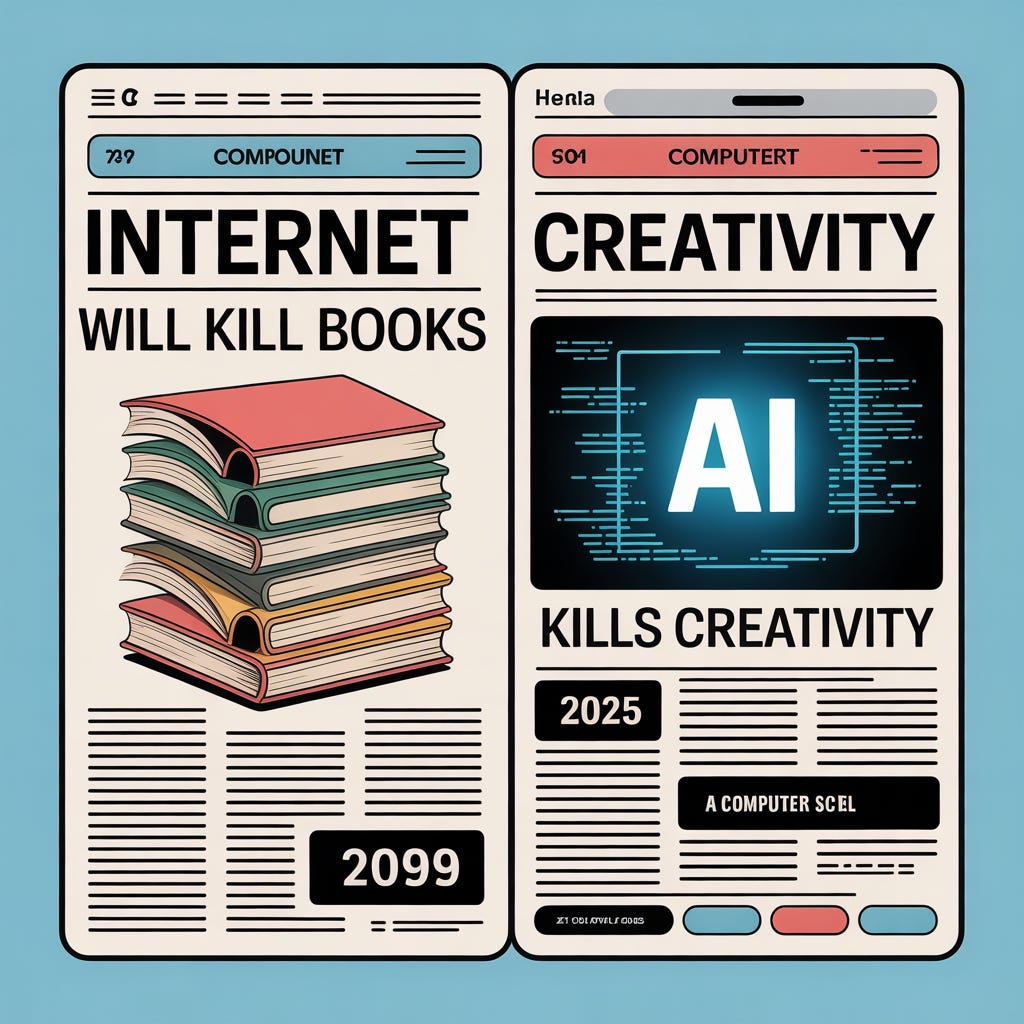
It was almost word-for-word what people said when the internet started in the ‘90s. Books would die. Libraries would close. Artists and writers would become irrelevant because everything would be digital and automated.
I sat there staring at my screen and suddenly laughed.
Actually laughed out loud.
Because here I was—decades after those predictions—still writing. Still creating. The internet hadn’t killed creativity. It had expanded it beyond anything we imagined.
I realized I’d been scared of the internet too, back then. And I survived. Adapted. Thrived, even.
This time was different. I got tired of trying to plot the future based on everyone’s dire predictions.
I’d already lived through one “creativity apocalypse” that never came.
Maybe AI was just the next expansion, not the final ending.
———————
The Internal Battle That Had to Happen
Fear: “This is stupid. Everyone’s doing this AI thing better than you. Just quit.”
Logic: “But you’ve invested years into this. Walking away now—”
Fear: “Years of what? Being mediocre while AI does everything better? People told you that you had nothing to say, and they were right.”
Logic: “That’s not fair. You’ve built something here.”
Fear: “Built what? A collection of ideas that AI can generate in 30 seconds?”
Wise Self: “Hold on. You’re putting expectations on this that aren’t real. You’re making AI the enemy instead of asking what’s actually true here.”
Fear: “What’s true is I’m not good enough anymore. I thought I was exceptional—turns out I’m just another writer in a world that doesn’t need writers.”
Wise Self: “No. What’s true is you forgot why you started writing in the first place. It wasn’t to be the only one with an idea. It wasn’t to prove you were exceptional.”
Logic: “Then why? Why keep going?”
Wise Self: “Because writing is the expression itself. It’s not a means to prove your worth—it IS your worth. People mean everything, not just as a means to an end. The writing means everything too. Not as a path to recognition, but as the act of creating.”
Fear: “But what if it’s not good enough?”
Wise Self: “Good enough for what? You’re fighting expectations of what should be happening instead of seeing what really is. What if you just... wrote? What if you let AI be a tool instead of a threat?”
I let all parts of myself have a say.
Then I combined it into something that sounded viable. Stop fighting. Start creating. Use whatever tools help you express what you see.
———————
The Surprising Truth About Creativity
I reminded myself that money and expectations weren’t the end goal.
Writing was not the means to get somewhere else.
Writing is both the means and the end.
It’s the same twisted thinking that treats people as means to the end of making money—as if people don’t mean anything. But people mean everything.
And the writing? The creative expression? It means everything too.
I was fighting my expectations of what should be happening instead of accepting what really was.
Once I stopped fighting, something shifted.
"You never change things by fighting the existing reality. To change something, build a new model that makes the existing model obsolete."-Buckminister Fuller
It became possible to enjoy the writing again. To enjoy the people I was meeting. To see AI not as competition but as a tool that could expand what I was capable of creating.
Nobody has truly original ideas anyway. We all steal from somewhere.
You read an interesting book, combine it with another interesting idea, and now you have “your” idea.
I thought I was working on the edge of neuroplasticity and mindset—arrogant, I know.
Then I watched videos of people light-years ahead of where I am.
At first, my ego shut down. It couldn’t take the hit.
Then I felt relief.
There were maps of where we’re going. And I could take those ideas and adapt them for my own brain.
Kinda original.
———————
What Actually Doesn’t Work (I Tried Both Extremes)
What doesn’t work? Treating AI like it’s 1999 internet fears all over again.
I tried it.
I avoided AI for weeks, thinking I was protecting my creativity by keeping it “pure” and human-only. I zealously guarded my ideas like they were so revolutionary someone would want to steal them.
But really? I was terrified they weren’t good enough to matter.
People (including me) keep trying to protect creativity by avoiding the tools that could expand it. We get stuck in either/or thinking. Either I’m creative on my own OR I’m just another AI user with nothing original.
I also tried the other extreme—putting a thought into AI and watching it generate a whole book, then feeling worthless because “why bother if a machine can do this?”
Both approaches missed the point.
Creativity was never about being the only person with an idea. It’s about how YOU express what you see in the world. It’s about the connections YOU make that no one else makes quite the same way.
What works instead. Find your own creative expression and go with it. Let AI expand that if it helps you grow faster. Stop putting expectations on how things “should” work out and stay open to the unexpected—which can be even better than what you expected.
Our creativity needs to be expressed, period.
The tool you use doesn’t determine if it’s “real” creativity or not.
———————
The Survival Pattern We’re All Living
This is basic survival 101.
Our brains are wired for pattern recognition—to spot threats and keep us safe. When something new and powerful emerges, our ancient survival programming kicks in. We see threat, not opportunity.
I was looking for danger around every corner. Trying to force things to go the way I expected. Making AI the competition instead of recognizing it as a tool.
But here’s what I discovered. Our job isn’t to will the world into being what we want it to be.
The world is going to do what it does.
Our job is to see the world as it is and respond to that reality.
Identify your expectations and learn to let them go. We can’t control the future. We can only see clearly in the present and respond with curiosity instead of fear.
This mindset shift does away with the fear mindset and allows us to enjoy and see opportunity where we wouldn’t have before.
———————
What I’d Tell My Past Self (And You, If You’re Stuck)
I’d tell them what I wish someone had told me when I was paralyzed with fear.
AI isn’t here to replace your creativity—it’s here to show you how much creative capacity you actually have when you stop fighting and start creating.
Your voice matters.
Not because it’s exceptional or revolutionary or the only one saying these things.
It matters because it’s YOURS. The specific way YOU connect ideas, the particular lens through which YOU see the world, the unique expression that only YOU can create—that matters.
Stop guarding your thoughts like they’re so precious someone would steal them.
Instead, CREATE more. Express more. Use whatever tools help you get your vision out into the world faster and clearer.
And here’s the thing nobody tells you.
Creativity isn’t a gift that some people have and others don’t.
It’s a language. The language of nature. And nature is constantly adapting, always using new tools, always finding new ways to express itself.
Remember when the internet was supposed to kill books? Libraries? Human connection?
We survived that. We adapted. We found ways to use the internet to expand our creativity, not replace it.
We’ll survive AI too.
So lean into it. Believe in yourself more—not because you’re exceptional, but because your expression matters. Write for the joy of writing. Create for the act of creating.
Let AI be a tool, not a threat.
———————
The New Creative Reality We’re All Navigating
I’m starting to see AI doing what the internet did.
Expanding what’s possible.
Yes, predictions abound. Writing will become obsolete. Everyone will want real people, not AI. Everything is going video. There are supposedly more books on Amazon than people on the planet.
Funny—I still plan to write fiction.
I don’t use the AI detector anymore.
I still think for myself. If I read something and I like it, whoever put their name on it did good work. That’s enough for me.
Our creativity is more than a name on something.
It’s about digging deep in ourselves and putting our ideas together. It’s an expression of the beauty we see in the world reflected back from inside us.
Creativity is the language of nature.
And nature is adapting—always has been.
Maybe we should too.
Even if you’re on the leading edge of thinking in whatever you do, loosen up a little.
And if someone thinks your work is good enough to study with AI?
That’s a compliment, not a competition.
I can help you look at your anxiety to give yourself a successful start to the New Year.